Last updated November 18, 2026








Free in-home design visit - walk-in showers, tub-to-shower conversions, and Kohler, Moen, and Delta fixtures planned to your exact space
Bathroom Remodeling Warning Signs: A North Las Vegas Homeowner’s Reference Guide
Most bathroom problems we’re called out to inspect did not appear overnight. They announced themselves weeks or months earlier, with a soft spot underfoot, a fan that started sounding wrong, or a drawer that quit closing flush. The trouble is that homeowners misread those signals because nobody ever taught them which warnings are cosmetic and which are plumbing or structural. In a slab-foundation house, a spongy tile floor is rarely just tired grout; it can be water tracking under the slab, and by the time it’s obvious the repair is far bigger. This guide walks through the real warning signs, how to interpret each one, and when it’s time to schedule a free estimate in North Las Vegas.
Quick Answer
The main bathroom remodeling warning signs in North Las Vegas are soft or hollow-sounding floor tiles, grout that keeps re-cracking after repair, a fan that hums or moves little air, cabinet swelling near the sink base, and fixtures that show pitting or green-white crust rather than surface stain. Cosmetic staining wipes away; active water intrusion, motor failure and slow leaks don’t. When a sign persists after a simple fix, call a bathroom specialist for a free estimate before it grows into a slab or framing problem.
Styles & brands we work with
- Walk-in shower
- Tub-to-shower
- Freestanding tub
- Kohler
- Moen
- Delta
- Frameless glass
Table of Contents
- Why Bathroom Problems Are Usually Caught Too Late
- Visual Warning Signs: Cosmetic Versus Structural
- The Five-Minute Monthly Walkthrough
- Hard Water Staining Versus Fixture Corrosion
- Exhaust Fan Performance: When It’s Dying
- Vanity Swelling and Drawer Misalignment
- Slab-Foundation Warning Signs Unique to Whitney Homes
- Red Flags in a Remodel Quote Itself
Why Bathroom Problems Are Usually Caught Too Late
A bathroom failure is quiet by design. Water intrudes behind tile slowly, exhaust motors fade gradually, and cabinet bases swell over months. By the time a North Las Vegas homeowner calls, the visible symptom is usually the last stage of a problem that started long before. That’s why the interpretation matters more than the symptom itself. A re-cracked grout joint under a shower valve is not a grout problem, it’s a sign the substrate is moving or holding moisture.
Our technicians have up to 9 years of experience reading these signals, and the pattern is consistent: cosmetic issues are surface-level and resolve with cleaning or re-sealing, while structural and plumbing signals recur in the same spot no matter how many times you patch them. The difference between the two determines whether you’re looking at a weekend touch-up or a tub-to-shower conversion that finally solves the leak path.
Here’s the mental model that saves the most money. Ask one question of every warning: does this sign keep coming back in the exact same place? A stain that returns to the same grout line, a fan that keeps getting louder after you clean it, a drawer that re-sticks after you tighten it – recurrence points to an underlying cause, not a cosmetic nuisance. When you see recurrence, that’s when a free estimate from a bathroom specialist in North Las Vegas is worth more than another tube of caulk.
Visual Warning Signs: Cosmetic Versus Structural
Learning to separate cosmetic from structural signs is the single most valuable skill in this guide. Cosmetic issues affect appearance only. Structural signs mean water is getting where it shouldn’t, or a substrate is failing. Here’s how to tell them apart at a glance.
Cosmetic Signs (Usually a Touch-Up)
- Soap scum, mineral film, or mildew that cleans off with a bathroom cleaner
- Caulk that’s discolored but still bonded and flexible
- Grout lines that look dingy but stay tight and firm to the touch
- Faded grout color, or a chipped tile edge with no hollow sound behind it
- Surface scratches on a fixture finish
Structural or Plumbing Signs (Usually Worth a Look)
- Tile that sounds hollow or flexes when you press on it
- Grout that cracks repeatedly in the same line
- Bubbling paint on the ceiling below the bathroom, or a stain that spreads
- Soft, spongy floor at the toilet base or shower threshold
- Water stains low on the wall behind the vanity
- A musty smell that returns after deep cleaning
The hollow-sound test is quick and free: tap a tile with a wooden handle. A sharp, solid click means the tile is bonded; a dull, hollow thud means it’s lifting off the substrate. If several tiles in one area sound hollow, that’s a structural signal, not a cosmetic one. In our experience across North Las Vegas bathrooms, recurring hollow tiles near the shower or tub mean water has been getting under the tile for a while.
Behind every good-looking tile job there’s a waterproofing layer you never see after install. That’s why we build showers around Schluter Systems waterproofing and edge profiles rather than counting on tile and grout alone to keep water out. Grout is not waterproof; it’s water-resistant at best, and it cracks as a house shifts. The membrane behind it is what actually protects the framing and the slab.
The Five-Minute Monthly Walkthrough
Catching bathroom problems early takes about five minutes a month. Do these steps in order and you’ll understand your bathroom’s condition without tools or expertise. This is the single best habit for a homeowner who wants to avoid a surprise remodel.
- Check the ceiling below the bathroom. A faint ring, bubbling paint, or a fresh stain means water is working through. Note the exact location; it points to what’s above it.
- Press the floor around the toilet and shower threshold. Any give or sponginess is a structural sign, not cosmetic. Compare it to firm floor elsewhere.
- Tap a few floor tiles with a wooden handle. Listen for a hollow thud instead of a solid click, especially near the tub or shower.
- Open and close every vanity drawer and cabinet door. A drawer that rubs or a door that swings open is a humidity or leveling signal worth watching.
- Run the exhaust fan for five minutes and stand near it. Feel the airflow with your hand and listen. Weak airflow or a new hum means the fan is losing performance.
- Look at the base of every fixture. Check for a crust, pitting, or a greenish film around the supply lines and shut-off valves.
- Smell the room after you leave it closed for a few hours. A faint musty odor that returns after cleaning points to moisture hidden somewhere.
Do this walkthrough on the same day each month, ideally after a shower has run, because moisture is most active then. The point isn’t to become a plumber, it’s to notice change. A sign that’s stable for a year is far less urgent than one that’s worse this month than last.
Hard Water Staining Versus Fixture Corrosion
North Las Vegas water is hard, and hard water leaves its mark on faucets and showerheads. That staining and early corrosion can look nearly identical, but they require completely different responses. One is cleaned; the other signals a fixture near the end of its life, or a valve issue worth addressing before a remodel.
Hard Water Staining
- White or cloudy film that wipes off with a mild acid cleaner, or comes back slowly
- Spots and rings that dissolve with vinegar or a descaler
- The metal underneath stays smooth and shiny once cleaned
- Most common on showerheads, faucet aerators and the glass of a shower door
Early Fixture Corrosion
- Pitting, flaking chrome, or a rough texture that won’t wipe smooth
- A green-white crust around the base of a faucet or the supply line connection
- Discoloration that starts at the seams and spreads outward
- A drip at the spout or base that keeps returning after you tighten things
Try this test before you worry: clean a stubborn spot with a mild descaler and look again in a few days. If the surface underneath is smooth and bright, you’re dealing with hard water. If the spot returns with a crust, or the metal is pitted and rough, that’s corrosion, and it usually means the fixture or its internal valve is due for replacement. Corrosion at a supply line can also point to a slow leak behind the wall, which is a bigger matter.
This is one reason brand and finish choice matters during a remodel. A faucet from a well-made line holds up better to hard water than a builder-grade one, and our portfolio lets you choose by budget, from Sterling for accessible quality to Grohe and Toto for top-tier performance. If you’re weighing Bathroom Remodeling North Las Vegas, getting the finish and the fixture right the first time heads off this exact problem.
Exhaust Fan Performance: When It’s Dying
An exhaust fan that’s failing rarely stops all at once. It degrades, and the change is easy to miss because it happens over months. Catching the decline matters, because a weak fan leaves moisture in the room that feeds mold behind the shower wall and softens the drywall above it. Here’s what to listen and feel for.
Signs the Motor Is Near Failure
- A new or worsening hum or grind that you hear from the next room
- The fan gets noticeably louder but moves less air
- A rattle or buzz that shows up on startup and fades after a minute
- You have to start and stop the fan a couple of times before it spins
- The motor housing feels hot to the touch after a short run
- Moisture still clings to the mirror and walls after a full shower
Signs It’s Just Routine Dust Loading
- Steady, smooth sound with no rattle or grind
- Airflow drops gradually until you clean the grille, then returns
- Dust or fuzz visible on the grille or inside the housing
- The fan spins up normally every time
The quick test: hold a single square of thin tissue against the grille. A healthy fan holds it easily; a tired one lets it drop. If airflow stays weak after you’ve cleaned the grille and the sound has changed, it’s the motor, not the dust. That distinction saves a lot of money – cleaning is free, and replacing a fan motor is a small job compared to repairing mold behind a shower wall.
Fan age, not just sound, matters. A fan that’s running past its expected life and no longer holds a tissue is a candidate for replacement during a remodel, especially when we’re already opening the wall for a walk-in shower install. If your fan and your shower are both at their limit, that’s when to compare a full walk in shower upgrade rather than patch the two separately.
Vanity Swelling and Drawer Misalignment
Vanity warnings are often read as furniture problems when they’re really moisture or leak signals. The vanity sits directly under the sink, which means it’s the first thing to react to a slow supply-line drip or a drain leak. Swelling, sticking drawers, and a door that won’t close flush can all be telltale signs of water you can’t see.
When It’s Fluctuation (Usually Harmless)
- A drawer that rubs or sticks in summer and frees up in drier weather
- Doors that swing or don’t line up during the most humid weeks
- Minor gaps that open and close with the seasons
- No musty smell, no soft edges, no water stains
When It’s a Slow Leak
- Swelling at the very bottom of the cabinet, near the floor
- Discoloration or a dark water line on the cabinet back or sides
- A soft, crumbly edge on the cabinet base or the bottom of a drawer box
- Drawers misaligned in the same direction, month after month
- A persistent musty smell when you open the cabinet doors
Distinguishing the two is simple. Run a paper towel along the back inside of the vanity, under the sink lines. If it picks up moisture or shows a rusty or dark tinge, there’s a slow drip, and the fix is plumbing before the cabinet fails entirely. In our experience, the most common hidden leak in North Las Vegas bathrooms is at the supply connection under the sink, where hard water and a small drip over time soften the cabinet base.
Slab-Foundation Warning Signs Unique to Whitney Homes
Much of Whitney’s housing stock sits on slab foundations, and that single fact changes which warnings matter. In a slab home, the plumbing runs beneath the concrete floor rather than underneath a crawl space or in a pier-and-beam structure. That means water from a slab leak has nowhere to drain and instead travels sideways under the flooring, softening tile and grout from below. A homeowner in pier-and-beam construction watches a different set of clues entirely.
Slab-Foundation Warnings (Watch These in Whitney)
- Warm or hot patches on the floor near the bathroom, which can point to a hot-water line leak
- Soft, spongy or hollow tiles over a whole area rather than one spot
- Grout cracking in a line that runs outward from the toilet or shower
- A spreading damp smell in the bathroom that returns after cleaning
- Unexplained spikes in a water bill with no visible drip
- The sound of water running when nothing in the house is on
The water meter test is the clearest slab warning a homeowner can run. Turn off every faucet, appliance and outdoor spigot, then watch the meter for several minutes. If the dial moves, water is escaping somewhere, and in a slab house the bathroom floor is a common place for it to hide. A running toilet will also move the meter, so rule that out first by checking the tank.
These are the warnings a pier-and-beam homeowner never has to worry about, because their plumbing is accessible from below. In a slab home, a leak under the concrete is a job for a trained specialist and often a plumbing professional, not a DIY fix. Do not open a slab or drill into the floor to chase a suspected leak; that work belongs to someone qualified to locate and repair it without damaging the foundation. If you’re noticing these signals in your Whitney home, it’s time for a professional look, which is where our Whitney service area comes in.
Red Flags in a Remodel Quote Itself
Warning signs aren’t only physical. The quote you receive is itself a signal of how a remodel will go, and reading it well is part of protecting your home. A bathroom is one of the most complex small spaces in a house, with plumbing, electrical, waterproofing and ventilation all meeting behind the walls. A vague quote for a space like that is a genuine risk.
- No line-item detail. A one-line “bathroom remodel: $X” tells you nothing about fixtures, waterproofing, or labor. Ask for a written line-item quote that names what’s included.
- No waterproofing plan. Tile and grout are not the moisture barrier. Ask specifically how the shower will be waterproofed behind the tile; a professional should be able to explain it clearly.
- Brand substitutions. “House-brand” fixtures aren’t necessarily bad, but you should know what you’re getting. You should be able to choose from named brands, not accept whatever shows up.
- Scope creep. A bathroom specialist stays in their lane. If the quote wanders into kitchens, roofing or general contracting, the focus that protects your project is diluted.
- No mention of ventilation. A remodel that ignores the exhaust fan will leave moisture in the walls long after the job is done.
- Pressure to skip the estimate. The written estimate is what sets the final price; a professional is glad to provide one for free and put it in writing.
Compare quotes carefully and ask the same questions of each. The right specialist will welcome them, not deflect them. A bathroom-only contractor who works daily with named fixture brands and professional waterproofing will be ready to walk you through every line, from the substrate to the trim.
Common Mistakes to Avoid
- Treating a soft floor as a grout problem. Grout is not waterproof, and in a North Las Vegas slab home, a spongy floor near the shower often means water is tracking under the concrete. Repainting the grout hides the symptom while the leak grows.
- Ignoring a fan that’s louder, not quieter. A fan that grinds or hums is often dying, not just dusty. A weak fan leaves moisture behind the shower wall, where mold and softened drywall follow.
- Confusing hard water film with corrosion. North Las Vegas water is hard, and the staining looks like corrosion. Clean a spot, then check it again in a few days; a returning crust means corroded metal, not mineral film.
- Sticking a towel in a swelling cabinet and moving on. A swollen vanity base near the floor or a misaligned drawer that never rights itself is often a slow drip at the sink connection. Fix the plumbing before the cabinet fails.
- Skipping the water meter test. In a slab home, a meter that moves with everything off is the clearest early warning of a hidden leak. Check it monthly, and rule out a running toilet first.
- Hiring on price alone. The cheapest quote in North Las Vegas often skips line-item detail or a waterproofing plan. The written estimate that shows what’s included is the one that protects you.
- Chasing a leak with a hammer. Never open a slab or drill into the floor to find water. A trained professional locates and repairs it without cracking the foundation.
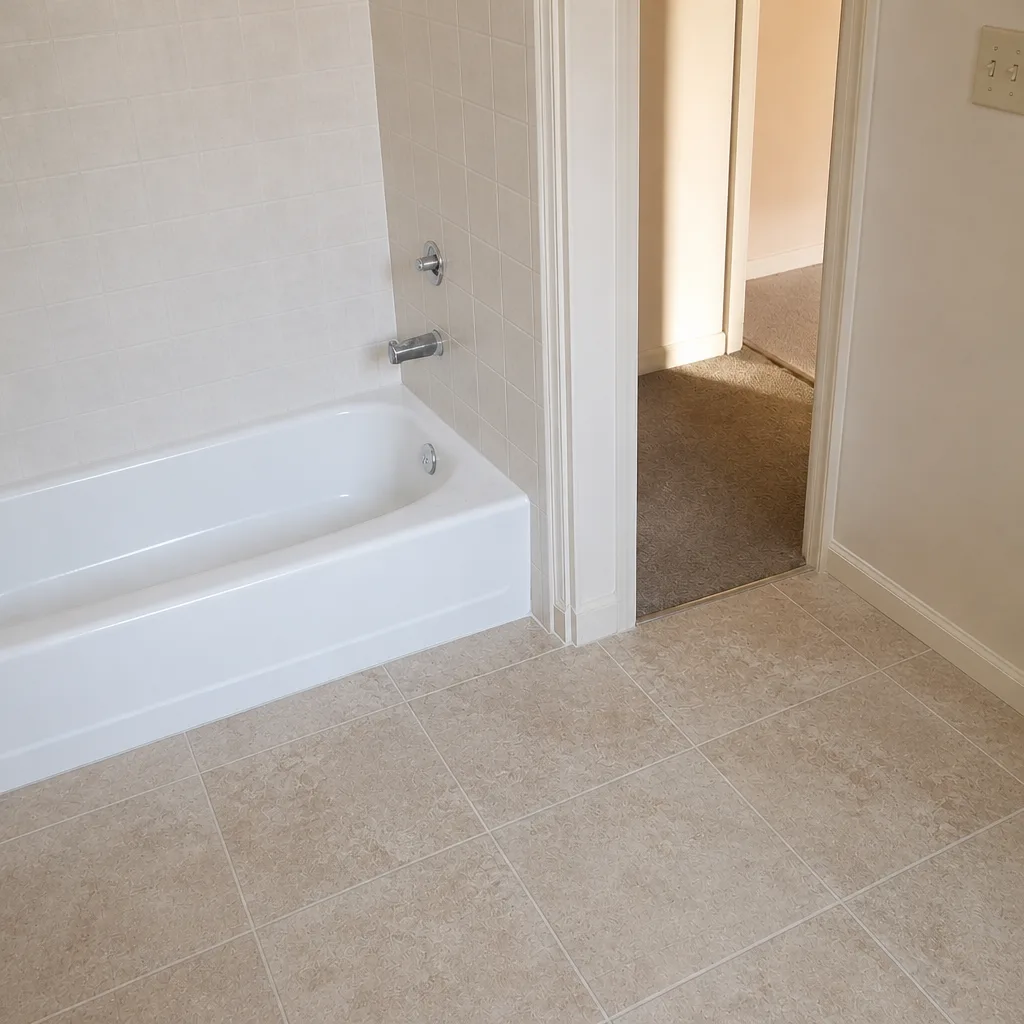
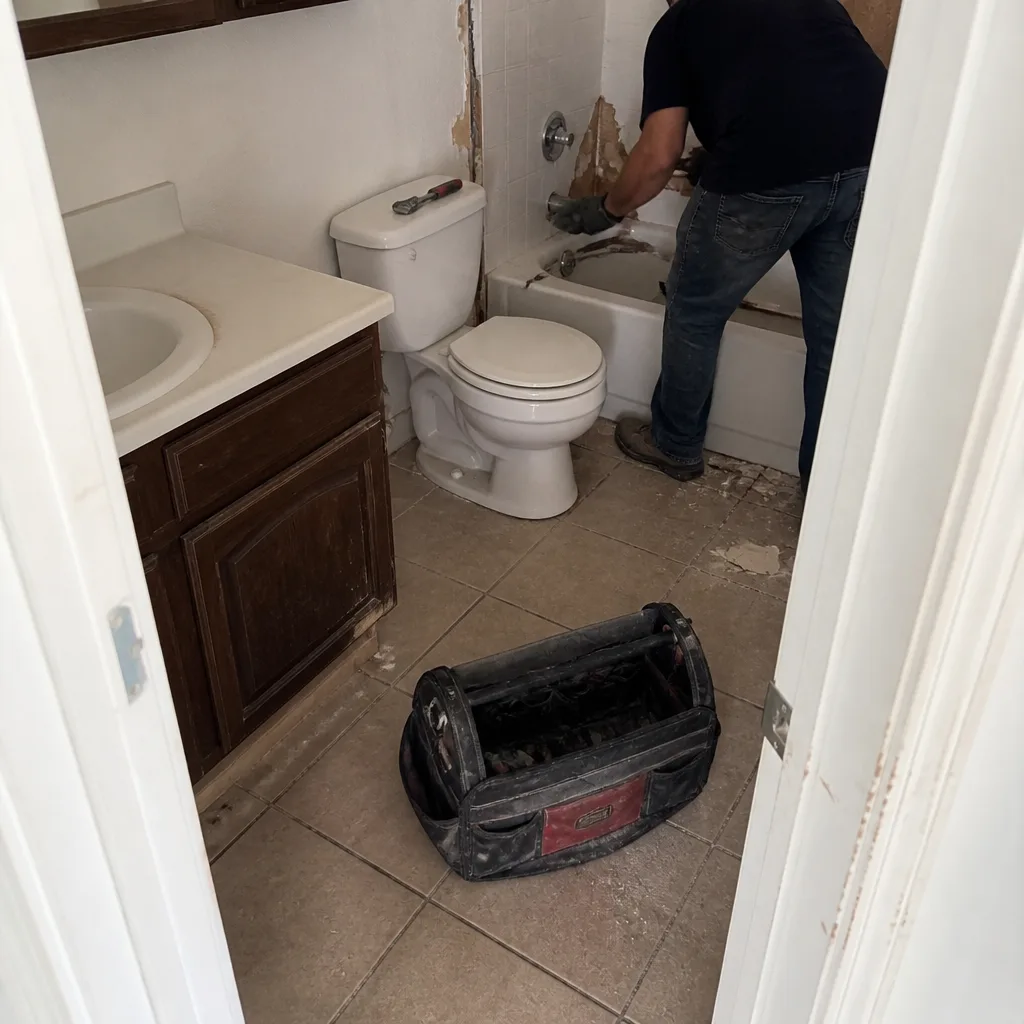
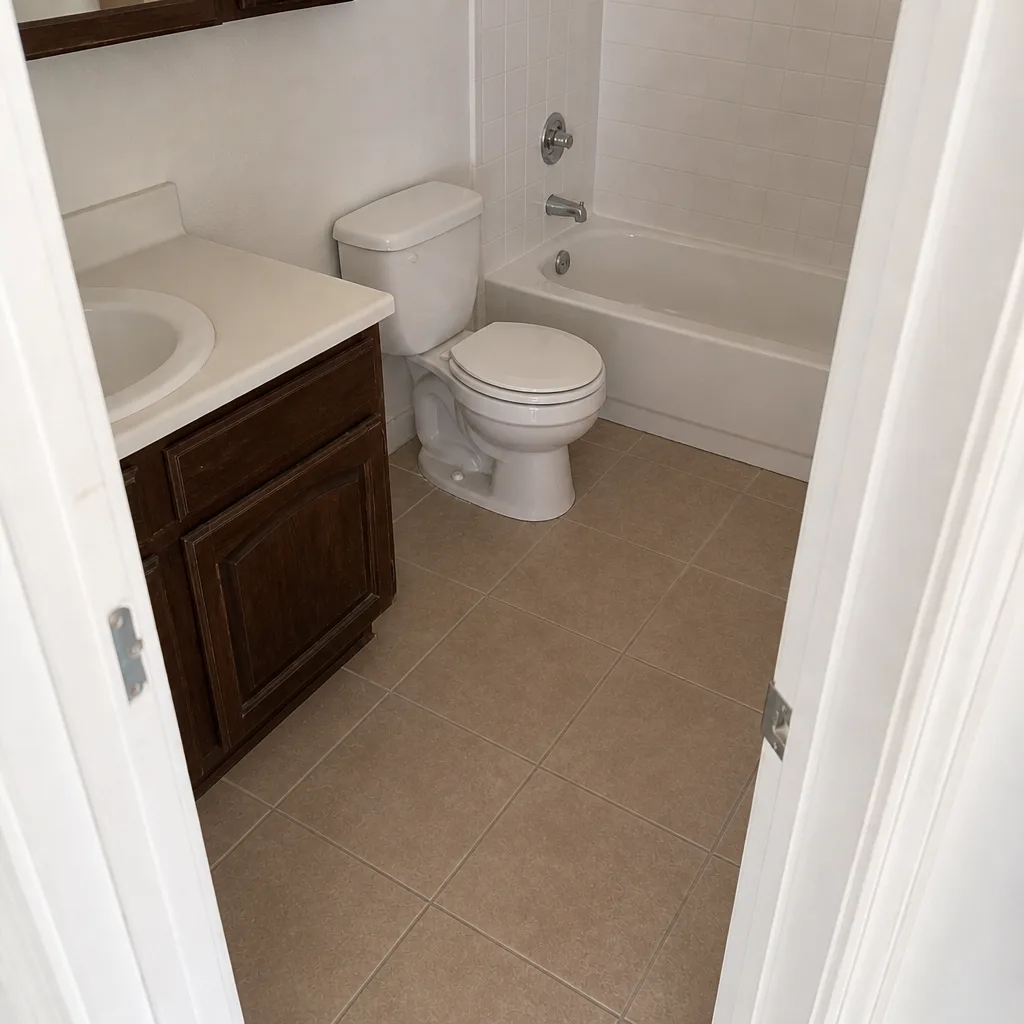
See the difference
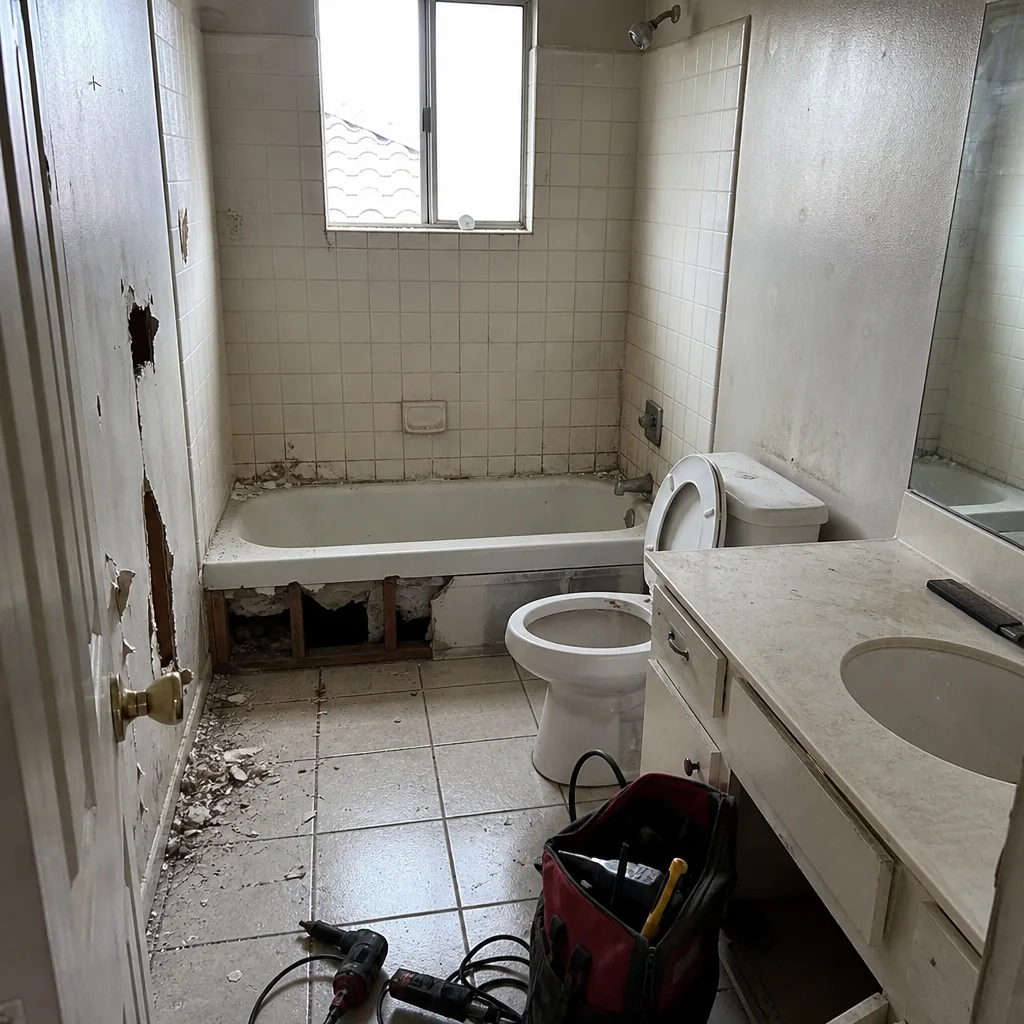 Before
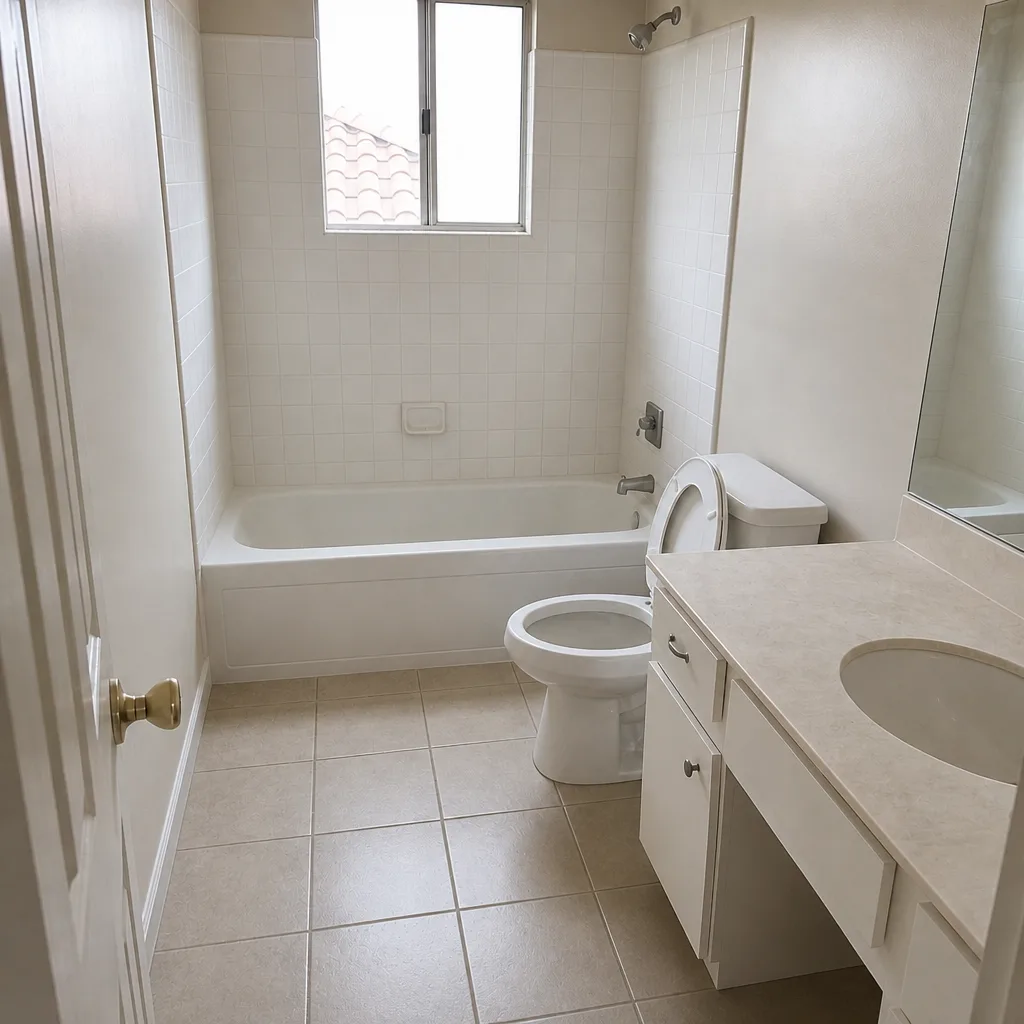 After
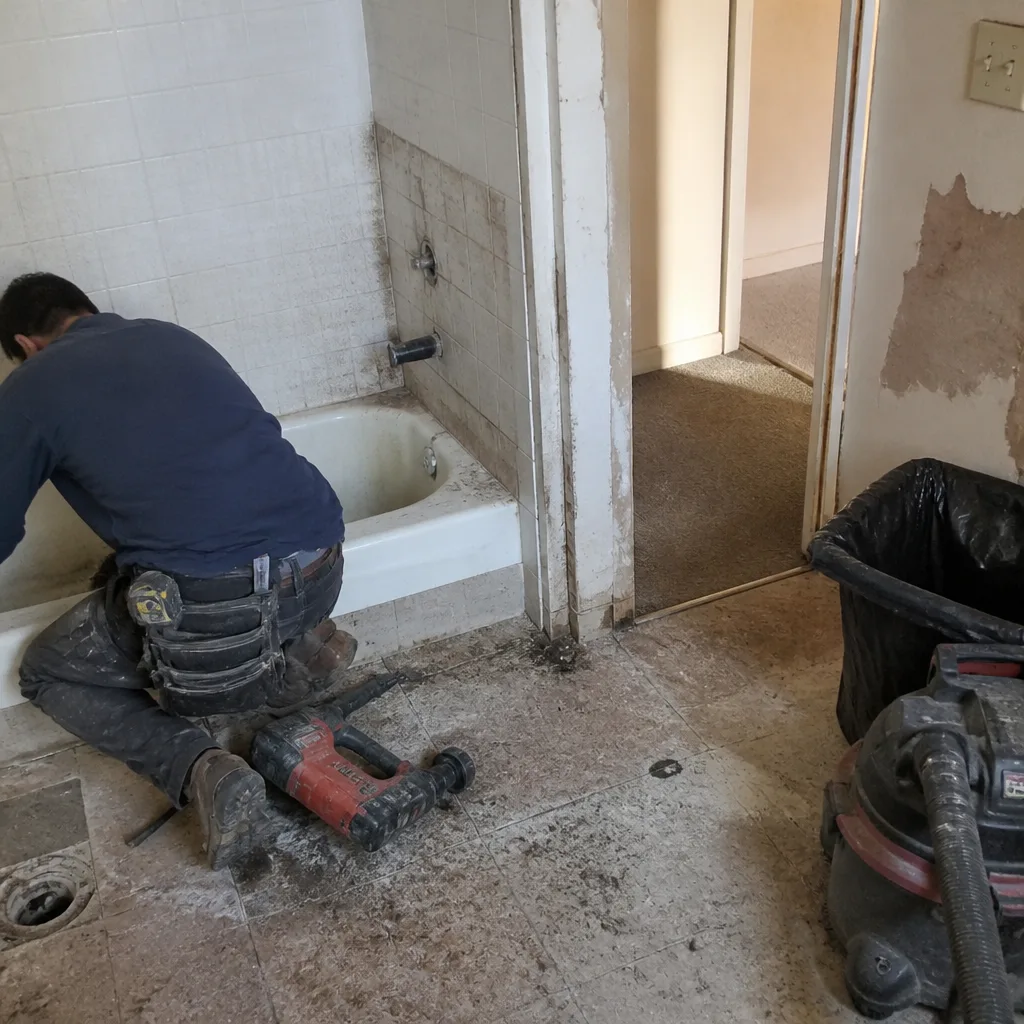 Before
 After
 Before
 After
When to Call a Professional
Call a professional when a warning sign recurs in the same place after a simple fix, when the floor feels soft, when the water meter moves with everything off, or when you see a fresh stain or bubbling paint on the ceiling below the bathroom. Call also if your vanity base is swelling near the floor or your exhaust fan has changed sound and no longer holds a tissue. These signals point to moisture behind the tile or under the slab, where a trained eye saves the most money. Our technicians have up to 9 years of experience interpreting exactly these signs, and our free estimates give you a clear read before the problem grows. Bathroom Remodeling North Las Vegas offers free estimates in North Las Vegas – call (844) 834-0636. We answer 24/7. Fast dispatch from 7am to 7pm, Sunday through Friday.
Frequently Asked Questions

A soft or spongy bathroom floor is usually serious because it points to water underneath, not just worn grout. In a slab-foundation home, the plumbing runs below the concrete, so a leak has nowhere to drain and softens the floor from below. Tap the area: a hollow thud instead of a solid click, especially near the toilet or shower, means the tile is lifting off its substrate. That’s a job to have inspected by a professional. Call (844) 834-0636 for a free estimate.
Hard water staining wipes off and leaves smooth, bright metal underneath, while corrosion leaves pitting, a rough texture and a green-white crust that returns. North Las Vegas water is hard, so mineral film is common and cosmetic. The deciding test is time: clean the spot, then recheck in a few days. A crust that comes back, or a roughened, pitted surface, means the fixture or its valve is failing and worth replacing. Call (844) 834-0636 for an exact quote, and estimates are free.
A bathroom exhaust fan that gets louder but moves less air is often near the end of its motor life, not just dusty. Hold a single tissue against the grille; if it won’t stay up after you’ve cleaned the grille and the sound has changed, the motor is failing. A weak fan leaves moisture in the walls and feeds mold. Replacing it during a remodel is the efficient move. Call (844) 834-0636 for a free estimate.
Swelling at the bottom of a vanity cabinet in a Whitney home usually points to a slow leak at the sink supply line or drain, not seasonal humidity. Humidity makes a drawer stick and then free up, but a slow drip leaves a dark water line, a soft base, and a musty smell that never goes away. Run a paper towel along the inside back of the cabinet; a damp spot means plumbing is due. Call (844) 834-0636 to schedule an estimate.
A slab-leak warning affects an area and recurs, while a cosmetic issue stays surface-level. Watch for warm patches on the floor near the bathroom, hollow or spongy tile across a wide area, grout cracking in a line running out from the shower, or a water meter that moves with every fixture off. These point to water under the slab. Never open the concrete yourself; a trained professional locates the leak properly. Call (844) 834-0636 for a free estimate.
Repair when the issue is isolated and stable, and consider a remodel when the same warning keeps returning or water has reached behind the tile. If a shower has been leaking under the floor for years, patching tile won’t solve the source; a tub-to-shower conversion with proper waterproofing addresses both the leak path and the layout. A free estimate tells you which one your bathroom needs. Call (844) 834-0636. We answer 24/7. Fast dispatch from 7am to 7pm, Sunday through Friday.
The Bottom Line
Most bathroom emergencies in North Las Vegas announce themselves with quiet, recurring warning signs long before they turn expensive. A hollow-sounding tile, a fan that’s louder than it used to be, a cabinet swelling at the base, a crusty fixture, or a water meter that won’t sit still are all readable clues. The trick is not guessing at them but interpreting them: cosmetic issues stay surface-level and stable, structural ones recur in the same place. Teach yourself the five-minute monthly walkthrough, respect the slab warnings unique to Whitney homes, and read your remodel quote as carefully as your walls. When a sign recurs, get a free estimate from a bathroom specialist, not another tube of caulk. For bathroom remodeling grounded in a clear read of your home’s signals, that first conversation costs nothing.
Ready to understand your bathroom before it becomes an emergency? Call (844) 834-0636 for a free estimate. We answer 24/7. Fast dispatch from 7am to 7pm, Sunday through Friday.
Written by the team at Bathroom Remodeling North Las Vegas.